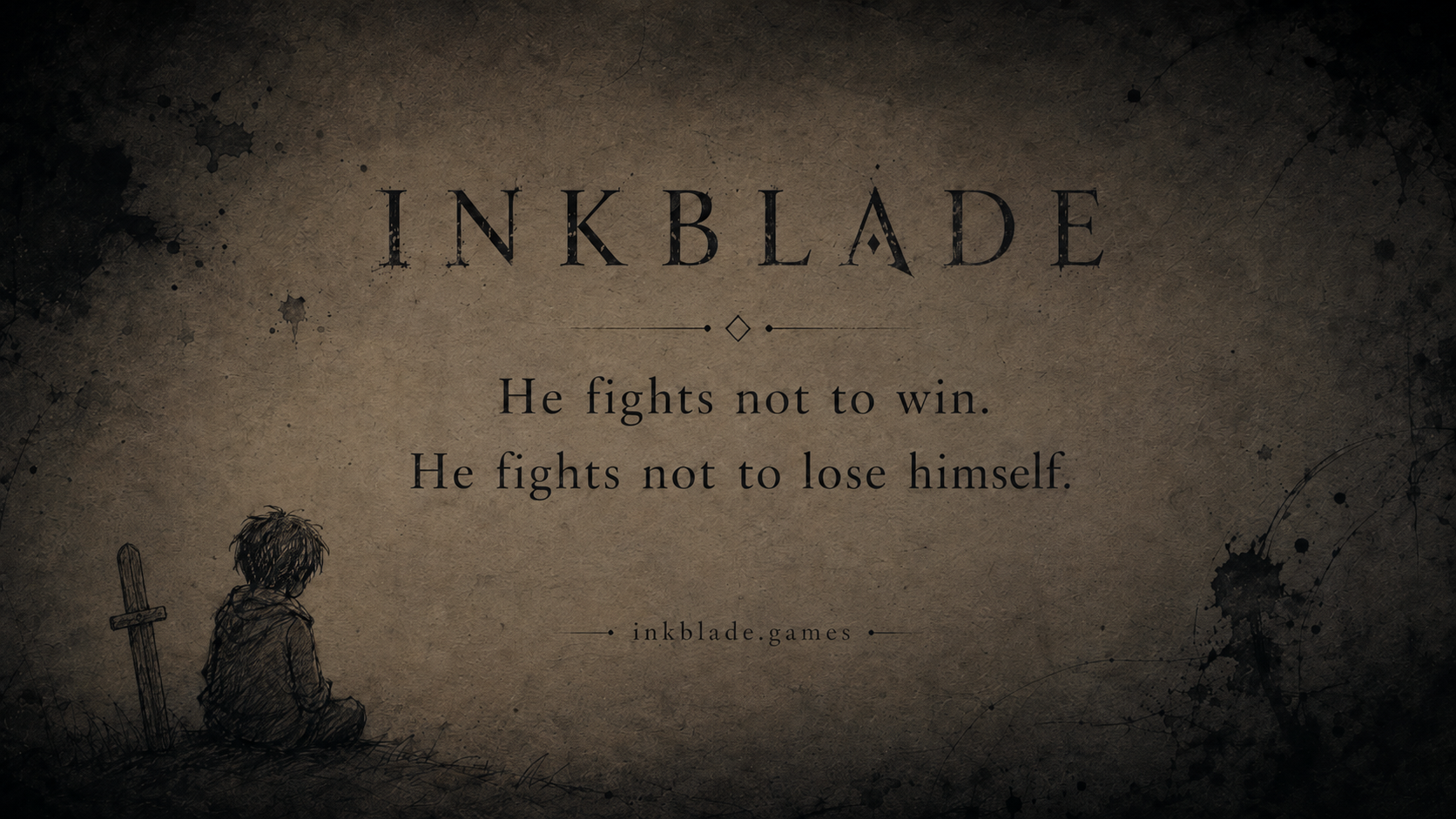
InkBlade Is Not Horror — It Is Emotional Dark Fantasy
InkBlade is not horror.
It has darkness, but it is not built to scare you.
It has monsters, but they are not there only to frighten you.
It has pain, but pain is not the point.
InkBlade is emotional dark fantasy.
It is a story-driven platformer about childhood fear, memory, inner monsters, and the fragile hope that survives inside darkness.
At first, InkBlade began as an idea for a platformer. A boy. A sword. A paper world. A knight. A few monsters. A dark atmosphere.
But the deeper the idea became, the more it stopped feeling like a simple game concept.
It became something more personal.
A game about a child who does not yet have the words for what hurts him.
A game about fear that changes shape as he grows.
A game about imagination not as escape, but as survival.
A game about the knight a child creates inside himself when the world becomes too heavy.
That is the heart of InkBlade.
Not horror.
A painful, melancholic, hopeful fairy tale.
Listen to the InkBlade Audio Note
Before reading the full article, you can listen to a short atmospheric audio note created for this piece — a spoken reflection on the real tone of InkBlade: pain, memory, melancholy, and the fragile light a child refuses to betray.
InkBlade Audio Note: He Fights Not to Win
[Insert audio player here]
Darkness Is Not the Goal
Darkness alone is easy.
A game can be dark by adding shadows, monsters, sad music, broken places, and danger. But darkness by itself does not create meaning.
Darkness becomes powerful only when there is something human inside it.
A memory.
A wound.
A child’s drawing.
A small hope.
A wooden sword held like it matters.
A fragile belief that something can still be saved.
InkBlade is not interested in darkness as decoration.
Its darkness has to mean something.
The dark is not there to say:
“Look how cruel this world is.”
It is there to ask:
What happens to a child when the world becomes too heavy?
What happens when fear arrives before language?
What happens when imagination becomes the only armor he has?
This is why InkBlade is closer to an emotional dark fantasy story than a horror game. Its darkness is not the point. The child inside that darkness is the point.
The Pain Has to Be Beautiful
InkBlade should hurt.
But not in a cheap way.
Not through shock.
Not through cruelty for cruelty’s sake.
Not through horror tricks.
Not through trying to make the player uncomfortable just to prove that the story is serious.
The pain in InkBlade has to be beautiful because childhood memory is often beautiful and painful at the same time.
A yard can be warm and frightening.
A toy can be innocent and tragic.
A notebook can be childish and sacred.
A wooden sword can be ridiculous and heartbreaking.
A small hero can be imaginary and still completely real.
That contradiction is important.
InkBlade lives in the place where sadness and wonder touch.
Where the world is dark, but not empty.
Where the child is afraid, but still moving.
Where the knight may not be real in the ordinary sense, but feels necessary in the only sense that matters.
This is also why childhood fears make powerful stories. A child’s fear can be small in cause and enormous in feeling. A shadow, a door, a notebook, or a wooden sword can become the beginning of an entire inner world.
A Monster Is Not Just a Monster
In InkBlade, monsters should not exist only because the game needs enemies.
A monster should carry emotional weight.
It can be fear.
It can be shame.
It can be anger.
It can be loneliness.
It can be the memory of helplessness.
It can be something the child cannot say, but still has to face.
That is why InkBlade belongs closer to emotional dark fantasy than horror.
Horror often asks:
What is hiding in the dark?
InkBlade asks:
Why did the dark take this shape?
A monster in InkBlade should feel like something remembered. Something drawn. Something that came from inside the child’s world and grew teeth.
It should not only attack.
It should reveal.
This is the same idea behind inner monsters in stories and games: the strongest monsters are not only external threats. They are fears, memories, wounds, and emotions given a visible shape.
The Paper Knight Is Not a Power Fantasy
The Paper Knight is not a superhero.
He is not a clean fantasy of strength.
He is not the boy’s perfect version of himself.
He is not an easy answer to fear.
The Paper Knight is more fragile than that.
He is what appears when the child does not know how to survive what he feels. He is imagination becoming armor. He is resistance drawn in paper and ink.
That is why he matters.
A real knight would make the story simpler.
A paper knight makes it more painful.
Because paper can tear.
Because ink can bleed.
Because a drawing can be brave and helpless at the same time.
The Paper Knight exists in that contradiction.
He is not proof that the child is safe.
He is proof that the child has not disappeared.
In that sense, InkBlade is not about a boy becoming a perfect hero. It is about a child creating a form of resistance before he has the words to explain why he needs one.
Hope in InkBlade Should Be Fragile
InkBlade is not a hopeless game.
But its hope should never feel easy.
The hope in InkBlade is not bright, loud, or triumphant. It is small. It is almost hidden. It is the kind of hope that survives quietly.
A light under a door.
A remembered voice.
A drawing made with serious childish faith.
A step forward after fear.
A hand that reaches for something, even when it may be too late.
This kind of hope is stronger than simple optimism.
It does not deny the darkness.
It exists inside it.
That is the tone InkBlade needs: not horror, not despair, not empty sadness, but melancholic hope.
The feeling that something has been hurt, maybe deeply, but not everything human has been destroyed.
That is also why darkness in InkBlade needs tenderness. Without tenderness, darkness becomes only decoration. With tenderness, it becomes a threat to something human.
Music Revealed the Soul of the Game
Sometimes a project does not fully reveal itself through mechanics, design documents, or genre labels.
Sometimes it reveals itself through a feeling.
A melody.
A voice.
A piece of music that suddenly makes the whole game feel real.
For InkBlade, music is not only background. It is part of the emotional language of the world.
The right music does not say:
“Be afraid.”
It says:
“This hurt.”
“This mattered.”
“This child still remembers.”
“This knight was drawn because there was no other way to keep going.”
That is the sound of InkBlade.
Pain.
Melancholy.
Hope.
A small light inside darkness.
Not horror.
A wound turning into a fairy tale.
This is why InkBlade belongs near the language of a dark fairy tale. Not because it is about castles or princesses, but because it treats childhood fear as something mythic, symbolic, and emotionally true.
Why InkBlade Is an Emotional Platformer
InkBlade is still a platformer.
Movement matters.
Combat matters.
Timing, danger, enemies, levels, and challenge matter.
But they are not enough by themselves.
In InkBlade, platforming should feel connected to emotion. A jump can feel uncertain. A pause can feel afraid. A fight can feel like panic, shame, anger, or resistance. A level can feel like a memory the player has to cross.
The game should not only ask the player to move forward.
It should ask:
What does it feel like to move forward when you are afraid?
That is why InkBlade is not only a dark fantasy platformer.
It is an emotional platformer.
A game where mechanics, atmosphere, music, monsters, and story all point toward the same inner wound.
This is also why 2D platformers can tell stories through gameplay. In the right context, movement, hesitation, combat, silence, and failure can all become part of the story.
The Real Tone of InkBlade
The tone of InkBlade is not horror.
It is not “scary.”
It is not “edgy.”
It is not darkness for style.
The tone is tragic, tender, melancholic, and hopeful.
It is the feeling of a child standing in a world too large for him.
The feeling of a wooden sword held like it can still matter.
The feeling of a monster that is really a fear with a body.
The feeling of music that hurts because it remembers something true.
InkBlade is about pain, but also about the refusal to become empty.
It is about fear, but also about imagination.
It is about darkness, but also about the small light that survives inside it.
It is about a child who cannot defeat everything, but still creates a knight.
That is what InkBlade is becoming.
Not horror.
An emotional dark fantasy platformer about childhood fear, memory, pain, and the fragile hope of not disappearing.