Why Inkblade Is a Platformer — Not a Metroidvania
InkBlade is not a game about finding the right path.
It is a game about standing up and moving forward.
When I started working on InkBlade, the question of genre came up very early. Many people expected a metroidvania — dark, atmospheric, focused on exploration, backtracking, and a large interconnected world.
I deliberately chose a different direction.
InkBlade is a story-driven platformer, not a metroidvania.
And here is why.
Platformer vs Metroidvania — the Difference in One Idea
If we strip away genre labels and speak plainly, the difference is simple:
A metroidvania is a labyrinth.
A platformer is a path.
In a typical metroidvania, the player:
- explores a single interconnected map;
- frequently backtracks;
- unlocks areas through new abilities;
- progresses by finding keys to closed doors.
In a platformer, the player:
- moves forward;
- overcomes levels one by one;
- learns through failure and repetition;
- feels rhythm, timing, tension, and momentum.
Both genres are strong.
But they speak to the player about different things.
A metroidvania asks:
Where can I go?
A platformer asks:
Can I take the next step?
That difference matters for InkBlade because its emotional structure is built around forward movement, fear, failure, and the decision to continue.
What Defines a Metroidvania?
Most metroidvania games share a clear set of traits:
- a large interconnected world map;
- heavy backtracking;
- progression through ability-based gates;
- exploration prioritized over tempo;
- disorientation as part of the experience;
- returning to earlier areas with new powers.
Metroidvania is a genre about understanding the world.
The player learns the map, remembers locked paths, gains abilities, returns to old places, and slowly turns confusion into mastery.
That can be powerful.
But InkBlade is not about mastering a labyrinth.
InkBlade is about moving through emotional pressure.
Why InkBlade Is Not a Metroidvania
InkBlade is not about the map.
It is about the moment.
I did not reject the metroidvania genre because it is bad. I rejected it because it breaks the core message of InkBlade.
InkBlade is a story about:
- fear in the here and now;
- falling and standing back up;
- choices that cannot be postponed;
- pain that cannot simply be routed around;
- a child moving forward because stopping would mean disappearing inside fear.
Backtracking weakens that tension.
Returning to safe zones, grinding upgrades “for later,” optimizing routes, and repeatedly moving through already-known spaces can distance the player from the immediacy of the emotional choice.
And for InkBlade, tension is essential.
The game is not asking the player to solve a map.
It is asking the player to cross a moment.
This is also why InkBlade belongs closer to narrative games than to exploration-first structure. The meaning is not only in where the player can go. It is in what the player has to face.
Why InkBlade Is a Platformer
The platformer genre aligns naturally with InkBlade’s philosophy.
A platformer is direct. Physical. Immediate.
The player jumps, falls, hesitates, tries again, learns timing, feels pressure, and moves forward through challenge.
That is exactly the emotional rhythm InkBlade needs.
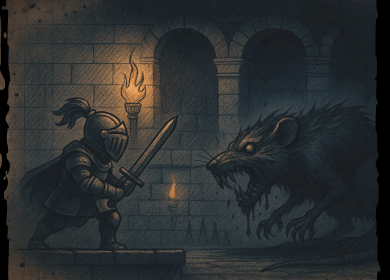
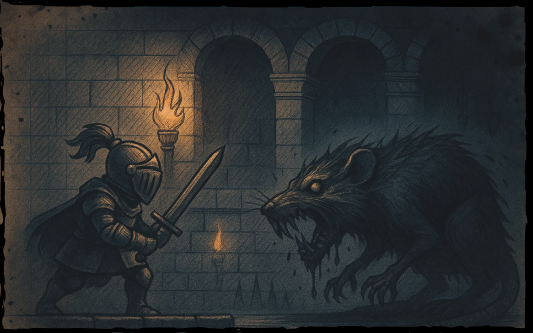
InkBlade is a dark fantasy story-driven 2D platformer about childhood fear, memory, inner monsters, and the fragile light a child refuses to betray. Its structure needs to feel like an emotional path, not a maze.
1. A Level Is a Trial, Not a Route
In InkBlade, a level is not only a route to optimize.
It is a trial.
You are not searching for a workaround.
You move through the challenge.
That is important because InkBlade is not about avoiding fear. It is about facing it. A platformer allows each level to become a concentrated emotional space: a yard, a room, a corridor, a memory, a fear, a moment the child has to cross.
This connects directly to how 2D platformers tell stories through gameplay. A level can carry meaning not only through dialogue or cutscenes, but through movement, distance, danger, rhythm, silence, and failure.
2. Falling Is Part of the Mechanic
In a platformer, falling is normal.
It is not only punishment.
It is learning.
InkBlade is built around a simple loop:
attempt → fail → repeat → grow
That loop fits the emotional core of the game.
The boy is not invincible.
The Paper Knight is not a perfect hero.
The player should feel effort, hesitation, danger, and recovery.
Falling and standing back up are not only mechanical actions. They are part of the meaning.
InkBlade is not about clean domination.
It is about trying again when the world feels too heavy.
3. Rhythm Matters More Than Loot
In InkBlade, what matters is not only what the player collected.
What matters is how the player moved through the moment.
Timing.
Pauses.
Jump precision.
The weight of impact.
The distance before a dangerous step.
The breath before entering a dark space.
This is the language the game speaks.
A metroidvania often rewards memory, exploration, ability progression, and map understanding. A platformer rewards rhythm, control, repetition, and the player’s growing relationship with movement.
For InkBlade, that is more emotionally honest.
The game should not feel like a checklist of upgrades.
It should feel like a child learning to move through fear.
4. Forward Movement Is a Metaphor
In InkBlade, forward movement is not only level design.
It is metaphor.
You cannot simply go back and erase decisions.
You cannot always return to the moment before the wound.
You cannot undo the first time the world stopped feeling safe.
Each level is a step forward.
Sometimes uncertain.
Sometimes painful.
Sometimes quiet.
Sometimes violent.
But forward.
This is why InkBlade is not a metroidvania. The emotional journey would lose force if the structure constantly pulled the player backward into optimization, routing, and safe repetition.
InkBlade needs the pressure of the next step.
Can a Game Be Both a Platformer and a Metroidvania?
Technically — yes.
Many games combine platforming mechanics with metroidvania structure. A game can have jumps, combat, exploration, backtracking, ability gates, and a connected map.
But philosophically, not every story needs that structure.
InkBlade consciously follows a focused platformer structure because what matters here is not what you unlocked.
What matters is who you became while moving forward.
The game is not built around a large map.
It is built around scenes, memories, emotional pressure, and the movement from one inner state to another.
This is why InkBlade is better described as an emotional story-driven platformer than as a metroidvania.
InkBlade Is a Story-Driven 2D Platformer
More precisely, InkBlade is a story-driven 2D platformer.
Here:
- story is told through actions, not only exposition;
- fear is expressed through mechanics;
- monsters are not only enemies, but emotional shapes;
- strength means control, not domination;
- movement carries narrative meaning;
- each level is part of the emotional path.
This connects InkBlade to narrative action-platformers: games where movement, combat, atmosphere, and story work together.
The genre was chosen not for a label.
It was chosen for meaning.
InkBlade is not a platformer because platformers are simpler.
InkBlade is a platformer because forward movement is the emotional truth of the game.
Why the Genre Choice Matters Emotionally
InkBlade is about a child, a wooden sword, a notebook, and the Paper Knight — the inner figure he creates when the world becomes too heavy.
That idea needs immediacy.
A child does not experience fear as a map.
He experiences it as a moment.
The dark room.
The step forward.
The fall.
The breath before trying again.
The monster that feels like a memory.
The small refusal to stop moving.
That is why the platformer form matters.
It gives the player a body inside the emotion.
InkBlade is not horror. It is emotional dark fantasy. Its darkness is not there only to scare the player. It is there to make every step feel like part of the child’s inner fight.
Frequently Asked Questions
Is InkBlade a Metroidvania?
No. InkBlade is a story-driven 2D platformer.
It does not focus on heavy backtracking, a single labyrinth-style map, or ability-gated exploration as its main structure.
What Is the Difference Between InkBlade and a Metroidvania?
A metroidvania usually focuses on exploration, backtracking, ability gates, and understanding a large interconnected map.
InkBlade focuses on forward movement, emotional tension, level-by-level progression, and story-driven platforming.
Why Is InkBlade Not an Open World or Large Interconnected Map?
Because InkBlade is about forward movement and emotional choice, not exploration for its own sake.
The game needs immediacy. Each level should feel like a step through fear, memory, and inner conflict.
What Kind of Platformer Is InkBlade?
InkBlade is a story-driven dark fantasy 2D platformer.
It uses movement, combat, atmosphere, music, and symbolic monsters to tell an emotional story about childhood fear, memory, and the Paper Knight.
What Games Is InkBlade Similar To?
InkBlade is closer in spirit to atmospheric narrative platformers where game feel, emotional tone, and inner tension matter more than collection systems or open-ended exploration.
It is not trying to be a traditional metroidvania.
It is trying to be a focused emotional platformer.
Instead of a Conclusion
Metroidvania asks:
Where can I go?
InkBlade asks something else:
Can I stand up and take the next step?
That is why InkBlade is a platformer.
Not because the world is simple.
Not because the path is easy.
But because sometimes the most important thing a character can do is not find another route.
Sometimes it is to stand up, face the moment, and move forward.