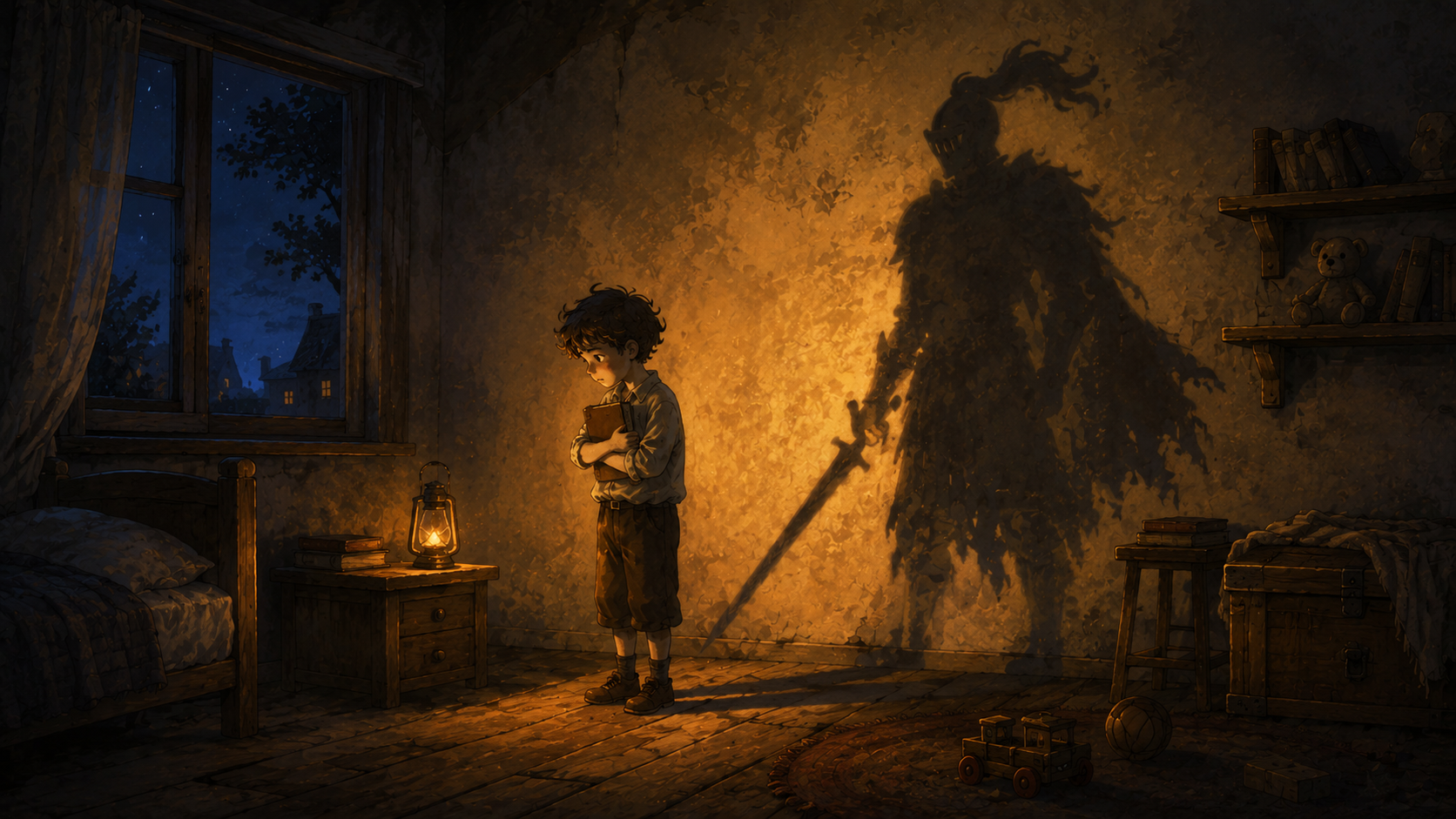
What Is a Narrative Action-Platformer — and How InkBlade Tells Story Through Gameplay
Some games tell stories through dialogue.
Some through cutscenes.
Some through journals, notes, and long explanations of the world.
But there is another way.
A story can be told through movement.
Through a jump.
Through a strike.
Through a fall.
Through the pause before taking a step.
Through a space that feels heavier than words.
InkBlade is a narrative action-platformer about a child trying to keep warmth inside himself after the world has already taught him to be afraid.
It is not simply a dark game.
Not simply a platformer with a sad story.
And not simply a story about fear.
InkBlade is built on the idea that the real world and the hero’s inner world are connected. What happens to the boy in reality is reflected in the world of the knight: in its levels, enemies, movement, combat, emptiness, and silence.
Here, story and gameplay do not exist separately.
They continue each other.
What Is a Narrative Action-Platformer?
A narrative action-platformer is a game where story, platforming, combat, and movement work as one system.
In a traditional platformer, the player jumps, avoids obstacles, clears levels, and gradually learns to control the character better. In an action-platformer, combat is added to that foundation: strikes, collisions, risk, and physical tension.
But a narrative action-platformer takes one more step.
Combat is not just a way to defeat an enemy.
A jump is not just a mechanic.
A fall is not just a mistake.
A level is not just a set of obstacles.
All of it becomes part of the storytelling.
If the character is afraid, the player should feel uncertainty.
If the hero is internally broken, the world should feel heavier.
If anger begins to grow inside him, combat should not feel clean or elegant.
If he experiences loss, the space around him may become empty, quiet, almost meaningless.
In this kind of game, gameplay does not only ask:
“Can you clear this level?”
It asks something else:
“What is the hero going through right now?”
That is why InkBlade is more accurately described not just as a story-driven platformer, but as a narrative action-platformer.
Narrative Games Are Not Only About Dialogue
When people hear the phrase narrative game, they often imagine dialogue choices, branching conversations, visual novels, or long story scenes.
Those can be narrative games.
But narrative in games can also live inside action.
A game narrative can be created by how the player moves, where the player hesitates, what the world hides, how combat feels, what happens after failure, and how the environment changes around the character.
That is why narrative games are not defined only by how much text they contain.
They are defined by how deeply story and play are connected.
In InkBlade, the story should not stop when gameplay begins.
The gameplay should be the story becoming physical.
InkBlade Begins With a Child’s Belief
For darkness to matter, there first has to be light.
InkBlade is not a story about someone who is born as a hero. It is a story about a child who first believes that being a hero is possible.
He has imagination.
He has a dream of courage.
He wants to protect.
He believes, in the simple way children do, that evil can be faced and defeated.
To an adult, it may look like play.
To him, it is real.
This is an important part of InkBlade: the hero does not begin as a symbol of pain. At first, there is light in him — innocence, belief in simple justice, and the desire to be someone who does not look away.
Then the world becomes more complicated.
Fear is no longer imaginary.
Darkness is no longer just a shadow.
And imagination becomes not entertainment, but a way to survive.
That is why childhood fears are so important to InkBlade. The game begins from the moment when simple fear becomes something larger — something that starts to shape the world inside the child.
The Knight Is Not a Power Fantasy
In many games, an inner fantasy works as a power fantasy: the character is weak, then gains strength, becomes powerful, and starts winning.
InkBlade takes a different path.
The knight in InkBlade is not a superhero.
Not beautiful armor made for victory.
Not a promise that everything can now be fixed.
The knight is an inner form of resistance.
When a child is afraid, when he is alone, when the familiar world no longer gives him a sense of safety, something is born inside him — an image that helps him avoid disappearing under the weight of fear.
But that image does not erase pain.
The knight does not make the hero invincible.
He does not remove consequences.
He does not turn everything back.
He simply becomes the shape of something inside the boy that refuses to give up.
That difference matters.
InkBlade does not say:
“Become strong, and everything will be fine.”
It asks:
“What remains inside you when you are afraid, but still have to move forward?”
This is why InkBlade is not horror. It is emotional dark fantasy: a story about pain, melancholy, hope, and the fragile light a child refuses to betray.
The Real World Hurts. The Knight’s World Answers.
In InkBlade, the fantasy world does not exist only for beauty or variety.
It is connected to the hero’s reality.
The real world leaves a mark.
The knight’s world turns that mark into space.
Fear can become a corridor.
Shame can become a suffocating level.
Anger can become a heavy fight.
Loss can become emptiness.
Memory can become a quiet place where something still echoes.
This approach makes the world of the game not just another fantasy location, but an inner geography.
Each zone can be more than a place. It can be a state of mind.
Each enemy can be more than an obstacle. It can be a form of pressure.
Each fall can be more than a player mistake. It can become part of the experience.
InkBlade uses platforming and action mechanics to show what the hero cannot always say out loud.
That is also why inner monsters matter so much here. A monster is not only an enemy. It can be fear, shame, anger, memory, or a wound given a body.
Why Combat in InkBlade Must Be Dramatic
InkBlade does not need combat for quantity.
It does not need dozens of identical enemies, endless combos, or constant action just to keep the pace moving. That kind of combat may be fun, but it can easily break the tone of the game.
Combat in InkBlade should be rare, physical, and meaningful.
Every fight should feel like a small story.
Not simply:
“I defeated an enemy.”
But:
“I got scared, fell, lost control, stood up again, struck back — and now I do not fully understand what is happening inside me.”
In InkBlade, combat matters not only as a test of skill. It has to be connected to the hero’s emotional state.
If the hero is afraid, combat may feel unstable.
If he is overwhelmed, enemies may not only attack him, but push him down and trap him.
If anger is growing inside him, strikes may become heavier and more frightening.
If he has experienced loss, even victory may feel empty.
In this way, action becomes not decoration, but a language for the story.
Story Through Consequences, Not Explanations
InkBlade is not only about what happens to the hero.
It is about what remains afterward.
Not just the moment of fear, but how it changes the way he walks.
Not just a fall, but why he does not immediately get up.
Not just a fight, but the silence after it.
Not just a right choice, but the price that choice demands.
Not just a loss, but the objects, gestures, and places that continue to remind him of what is no longer there.
A strong story-driven game does not have to explain everything.
Sometimes it is stronger to show:
someone not turning on the light;
washing too quickly;
hiding their hands;
staying silent when they should speak;
waiting in a place where no one will return.
These are the details that make a story feel alive.
InkBlade should tell not only events, but the consequences of events. Because consequences are what turn plot into experience.
InkBlade Is Not Misery for Its Own Sake
A dark game and a deep game are not the same thing.
A game can be heavy but empty.
It can show a lot of pain and still say nothing true.
It can push cruelty so hard that the player simply stops feeling anything.
InkBlade should work differently.
It is not about saying:
“The world is cruel.”
That is too simple.
InkBlade is about how a person tries to preserve warmth after the world has already hurt him.
That means darkness must exist alongside tenderness.
Fear alongside the memory of protection.
Pain alongside small human gestures.
Loss alongside the trace of something that was once alive.
Without that, the game would only be heavy.
With it, the game can become real.
Because what affects the player most is not cruelty itself. It is the contrast: a small warmth trying to survive inside a much larger fear.
Why InkBlade Is Not Just a Game About Bullying
From the outside, InkBlade may look like a game about school trauma, fear, and pressure.
But that is only one layer.
At its core, InkBlade is about how fear grows up with a person.
At first, fear may live in the dark.
Then in other people.
Then in someone else’s gaze.
Then in your own anger.
Then in closeness.
Then in loss.
Then in the understanding that not everything can be fixed, even if you try with everything you have.
Fear does not disappear.
It changes shape.
And growing up in InkBlade does not mean becoming a fearless hero.
True strength here is not the absence of fear.
True strength is entering even when you are afraid.
Not looking away, even when you cannot fix everything.
Not becoming empty, even after pain has taught you to close yourself off.
This is why coming-of-age stories often begin with fear. Growing up does not start when the child becomes strong. Sometimes it starts when the world stops feeling safe.
Platforming as the Language of an Inner Journey
Platforming is especially powerful for this kind of story because it is always connected to the body.
The player feels distance.
Feels the timing of a jump.
Feels a mistake.
Feels a fall.
Feels the next attempt.
In InkBlade, that matters.
A jump can be more than a jump.
It can be the decision to act.
A fall can be more than failure.
It can be part of the journey.
Repeating a section does not have to be punishment.
It can become a way of learning how to live with the thing that knocked you down.
Platformers are powerful because they turn abstract emotions — fear, hope, effort, hesitation — into simple physical actions.
That is why InkBlade works best not as a visual novel or pure drama, but as a game where the player moves through risk, error, impact, and return.
This is also why 2D platformers can tell stories through gameplay. A platformer can use rhythm, failure, movement, and space as emotional language.
Why InkBlade Is a Platformer, Not a Metroidvania
InkBlade is a platformer because it is about forward movement.
It is not built around backtracking, map optimization, or a large interconnected labyrinth. It is built around scenes, pressure, emotional progression, and the next step.
A metroidvania often asks:
Where can I go?
InkBlade asks:
Can I stand up and move forward?
That is why InkBlade is a platformer, not a metroidvania. The genre choice is not only technical. It is philosophical.
The structure of the game has to match the emotional truth of the story.
What Makes InkBlade Different
InkBlade does not want to simply tell the player:
“This boy is in pain.”
It wants the player to feel:
how pain changes space;
how fear changes movement;
how shame changes silence;
how anger changes a strike;
how loss changes the meaning of victory;
how a small tenderness can matter more than great strength.
That is what separates a narrative action-platformer from a regular story-driven platformer.
The story is not placed on top of the game.
The story becomes the game.
Conclusion
A narrative action-platformer is not simply a platformer with story and combat.
It is a game where movement, combat, falling, space, silence, and consequences become part of the storytelling.
InkBlade uses this form to tell the story of a child who creates a knight inside himself not for a beautiful victory, but for survival.
But the true strength of InkBlade is not that the hero becomes invincible.
It is something else.
He is afraid, but he moves forward.
He falls, but he rises.
He faces pain, but must not let it make him empty.
He learns that not everything can be saved, but still must not look away.
InkBlade is not a game about how pain makes a person stronger.
It is a game about how, after pain, something living can still remain inside.
FAQ
What Is a Narrative Action-Platformer?
A narrative action-platformer is a game where story, platforming, combat, and movement work together. The story is not revealed only through dialogue or cutscenes, but also through levels, collisions, falling, rhythm, and player action.
Is InkBlade a Story-Driven Platformer?
Yes. InkBlade can be described as a story-driven platformer, but more precisely, it is a narrative action-platformer because the game also uses action gameplay: movement, combat, risk, physical tension, and consequences.
Is InkBlade a Game About Bullying?
Not only. InkBlade may explore school pressure, fear, and humiliation, but the game is broader than that. It is about fear growing up, inner resistance, memory, loss, tenderness, and the ability not to look away.
Why Does InkBlade Have a Knight’s World?
The knight’s world reflects the hero’s inner state. It is not just a set of fantasy locations, but a way to show fear, shame, anger, loneliness, memory, and loss through gameplay.
Is InkBlade a Dark Game?
InkBlade can be dark and emotionally heavy, but its goal is not misery for its own sake. The main idea is not to show cruelty by itself, but to show the attempt to preserve warmth, humanity, and the ability to act after pain.
How Is InkBlade Different From a Regular Platformer?
A regular platformer is often built around clearing levels and mastering mechanics. InkBlade uses platforming and combat as the language of an inner story: every movement, fall, collision, and space can reflect the hero’s emotional state.