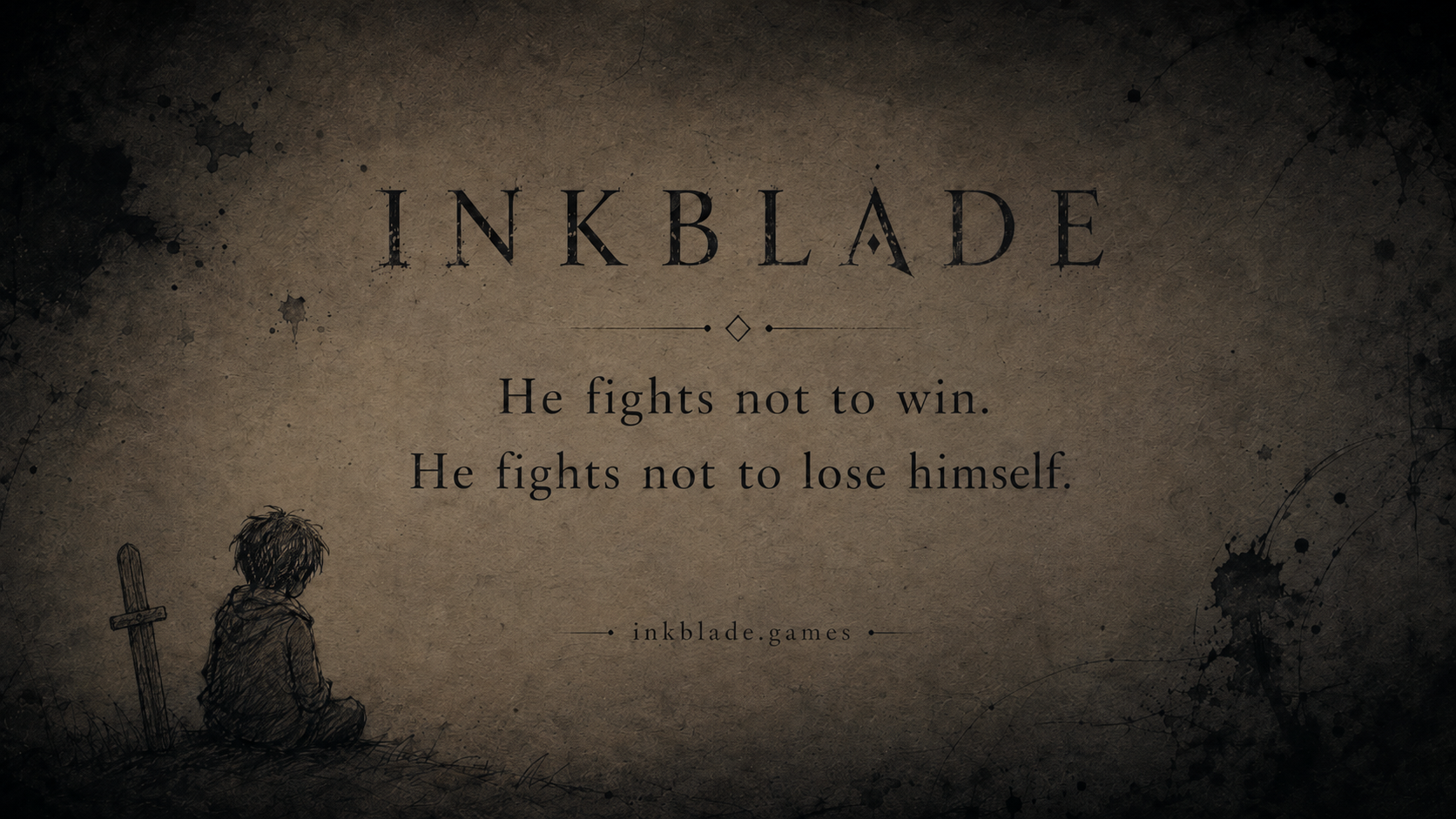
A dark fairy tale is not simply a story with monsters.
It is not dark because there is a forest.
It is not dark because someone gets lost.
It is not dark because a creature waits in the shadows.
InkBlade is not horror. It has darkness, but it is not built to scare you.It has monsters, but they are not there only to frighten you.It has pain, but pain…
Learn moreA dark fairy tale is not simply a story with monsters.
It is not dark because there is a forest.
It is not dark because someone gets lost.
It is not dark because a creature waits in the shadows.
Inner monsters are not always creatures hiding in the dark.
Sometimes they are memories.
Sometimes they are shame.
Sometimes they are anger that has nowhere else to go.
Sometimes they are the part of a person that was hurt long before they had words for it.
In stories, an inner monster is an invisible struggle given a visible shape. It is fear with a body. Pain with teeth. A memory that learned how to move.
That is why inner monsters are so powerful in fiction, fairy tales, dark fantasy, and narrative games. They allow a story to show what a character cannot easily say.
A monster can stand where a confession would be too simple.
A battle can reveal what dialogue would explain too directly.
A dark world can become the map of a wounded mind.
And when a story does this well, the monster is no longer just an enemy.
It becomes a question.
InkBlade Audio Note: Inner Monsters
A short spoken reflection on fear, memory, and the monsters we create before we understand what hurt us.
The simplest way to understand inner monsters is this:
An inner monster is an emotion that has become a creature.
Fear can become a shadow.
Shame can become a voice.
Anger can become a weapon.
Loneliness can become an empty room.
Guilt can become something that follows the character everywhere.
This does not mean every monster in a story has to be symbolic. Some monsters are simply monsters. But the ones that stay with us usually carry something deeper.
They are connected to a human feeling.
This is why inner monsters often appear in stories about childhood, memory, trauma, growing up, and identity. The character is not only fighting something outside themselves. They are facing something that already exists inside them.
That makes the fight more personal.
A monster outside the character can be defeated.
A monster inside the character must be understood.
Stories turn pain into monsters because pain is often difficult to describe directly.
A character can say:
“I am afraid.”
But a story can show a hallway that stretches longer every time the character tries to walk through it.
A character can say:
“I feel ashamed.”
But a story can show a creature that repeats every cruel word the character has ever heard.
A character can say:
“I am angry.”
But a story can show a sword becoming heavier, darker, and more dangerous each time it is used.
This is the strength of symbolic storytelling. It does not reduce emotion to explanation. It lets the audience feel the shape of it.
In this sense, inner monsters are not only scary. They are honest.
They show the truth of an emotion before the character can fully understand it.
This is closely connected to why childhood fears make powerful stories. Childhood fear often arrives before language. A child may not know how to explain loneliness, shame, or helplessness — but a story can turn those feelings into a monster, a room, a forest, or a knight drawn in a notebook.
One mistake many stories make is treating inner monsters as purely evil.
But the most interesting inner monsters are rarely that simple.
Sometimes they are protective.
Sometimes they are wounded.
Sometimes they are dangerous because they were created to help the character survive.
Sometimes they are a broken form of strength.
Anger, for example, can be destructive. But it can also appear after a person has been powerless for too long.
Fear can trap a character. But fear can also warn them that something is wrong.
A fantasy figure born from pain may look frightening, but it may have begun as a defense. A shield. A survival instinct. A way to keep going.
That is what makes inner monsters more interesting than ordinary enemies. They are not only obstacles. They are parts of the character’s emotional history.
The question is not always:
“How do we kill this monster?”
Sometimes the question is:
“Why did this monster have to exist?”
Games are especially good at showing inner monsters because games are not only watched. They are played.
A film can show a character walking into darkness.
A novel can describe the fear inside their mind.
But a game can make the player move through that darkness themselves.
This gives games a powerful way to express inner conflict.
A difficult jump can feel like hesitation.
A narrow corridor can feel like pressure.
A boss fight can feel like panic.
A level can become a memory.
A weapon can carry the weight of anger.
A pause before action can say more than dialogue.
This is why narrative games do not have to tell stories only through cutscenes or conversations. They can use movement, combat, failure, space, and atmosphere as part of the story.
In a story-driven game, the monster does not only ask the player to win.
It asks the player to feel what the character is facing.
In many games, combat is mainly mechanical. The player learns timing, attacks, defense, patterns, and enemy behavior.
That can be satisfying.
But in a narrative action game, combat can also carry emotional meaning.
A fight can feel desperate.
A fight can feel unfair.
A fight can feel like resistance.
A fight can feel like the character is becoming something they fear.
A fight can feel like the only language left.
This is where inner monsters work especially well in an action-platformer. The player is not only moving through levels and defeating enemies. The player is moving through emotional states.
That idea is central to a narrative action-platformer: a game where action, movement, atmosphere, and story are connected.
A monster can be placed in the level not only because the game needs danger, but because the character has reached a point where fear needs a body.
The battle becomes part of the storytelling.
Inner monsters often appear in dark stories, but darkness alone is not enough.
A dark platformer does not become meaningful because it has shadows, spikes, monsters, or sad music. It becomes meaningful when darkness is connected to emotion.
The player must feel that the world is dark for a reason.
A room should not only look frightening. It should feel connected to memory.
A monster should not only look strange. It should feel connected to fear.
A level should not only be dangerous. It should feel like something inside the character has changed.
This is why the best dark games are not just visually dark. They are emotionally dark.
As explored in what makes a dark platformer work, darkness becomes powerful when it has pressure, contrast, tenderness, and meaning.
Without meaning, a monster is decoration.
With meaning, a monster becomes a wound that moves.
Inner monsters are also powerful because they change as the character grows.
A child may fear the dark.
Later, that fear may become fear of being alone.
Later, fear of being alone may become fear of being abandoned.
Later, fear of being abandoned may become anger, control, silence, or emotional distance.
The monster changes because the person changes.
That is why inner monsters belong so naturally to coming-of-age stories. Growing up is not only about becoming stronger. It is also about understanding what fear has turned into over time.
A child may begin by imagining a monster under the bed.
Years later, the monster may no longer be under the bed.
It may be in the way he speaks.
In the way he fights.
In the way he refuses help.
In the way he mistakes anger for courage.
In the way he becomes afraid of his own strength.
This is where inner monsters become more than enemies. They become a way to show emotional transformation.
InkBlade is built around the idea that monsters are not just things to defeat.
They are memories.
They are fears.
They are emotional shapes.
They are the things a child cannot say, but still has to face.
At the center of InkBlade is a boy, a wooden sword, a notebook, and the Paper Knight — the inner figure he creates when the world becomes too heavy.
But the Paper Knight is not a simple fantasy of power. He is a response to fear. A form of resistance. A way for the child to keep moving when he does not yet have the words to explain what is happening inside him.
This is why InkBlade fits the language of a story-driven platformer. It is not only about crossing levels, fighting enemies, or reaching the end of a map. As explained in why InkBlade is a platformer, not a metroidvania, its structure is closer to emotional progression: scenes, memories, fears, and the forward movement of a character through darkness.
A monster in InkBlade should never be only a monster.
It should feel like something remembered.
Something feared.
Something drawn because it was too painful to say directly.
Inner monsters stay with us because they are not only about fantasy.
They are about recognition.
We may not have fought a creature made of shadow.
We may not have walked through a living notebook.
We may not have held a wooden sword against something impossible.
But we know what it means to fear something we cannot explain.
We know what it means to carry old emotions into new places.
We know what it means to become defensive before we understand why.
We know what it means to fight something outside ourselves and slowly realize it has roots inside us.
That is why inner monsters matter.
They make invisible things visible.
They turn emotion into image.
They turn memory into place.
They turn fear into conflict.
They turn silence into story.
And sometimes, they remind us that the monster was never only waiting in the dark.
Sometimes it was waiting for a name.
Childhood fears are rarely logical.
A shadow in the corner of the room.
A hallway that feels too long at night.
A door left slightly open.
A strange sound behind the wall.
The feeling that something is watching from under the bed.
A dark platformer is not simply a platformer with black backgrounds, monsters, and scary music.
A 2D platformer does not need long cutscenes or heavy dialogue to tell a story.
2D action platformer is a game genre that combines side-scrolling platform movement with action-based gameplay. In simple terms, it is a game where the player moves through 2D levels, jumps across obstacles, avoids danger, fights enemies, and gradually progresses through the world.